
Axora agents coordinate payer context, workflow signals, and documentation intelligence to surface denial risk before the claim leaves your system
Relevant payer policies, claim history, authorization records, and adjudication patterns are retrieved to ground recommendations in real payer behavior
Eligibility signals, coding logic, documentation context, and payer edits are evaluated together to detect cross-step inconsistencies
When risk appears, the issue is explained and routed to the appropriate workflow owner before the claim moves forward
Unlike traditional denial tools that rely on post-submission analytics or probability scoring, Optora identifies the operational cause of denial risk and surfaces the issue earlier in the workflow.
Optora analyzes eligibility signals, coding logic, documentation context, and payer behavior together to detect denial risk before the claim reaches the payer.
Documentation & Coding Accuracy
Clean Claim Engine
Denial Pattern Intelligence
Payer Rule Intelligence Layer
The Issue
A 150-bed hospital kept receiving "coverage terminated" denials.
The Axora Fix
Axora detected mid-cycle payer file changes and alerted front-office staff in real time.
The Result
Eligibility-related denials dropped visibly within 45 days.
The Issue
A specialty clinic faced quarterly spikes in modifier-related rejections.
The Axora Fix
Axora identified documentation gaps and predicted correct sequencing.
The Result
Loop disappeared from their denial heatmap the next month.
The Issue
A diagnostic network saw frequent payer-edit failures.
The Axora Fix
Axora's drift engine detected sequencing changes and auto-corrected claims.
The Result
First-pass yield climbed steadily month over month.
The Issue
A multi-centre hospital missed payer updates for high-volume procedures.
The Axora Fix
Axora flagged high-risk requests before submission.
The Result
Preventable denials reduced sharply within two cycles.
Optora reviews claims for the conditions most likely to result in a denial at the payer. This includes eligibility and coverage gaps, missing or invalid authorisation, medical necessity misalignments, coding inconsistencies, and payer-specific submission conflicts. Each risk is surfaced before the claim is submitted, with a clear explanation of what triggered the flag. Teams are not working from a denial letter after the fact. They are working from a pre-submission alert that tells them exactly where the risk is and what needs to change.
Optora draws on payer rules, historical denial patterns, and claim-level data to assess the likelihood that a given claim will be denied. Claims that share characteristics with previously denied cases like a particular code combination, a service type with a high denial rate under a specific payer, a documentation pattern that has triggered medical necessity reviews are flagged for review before submission. High-risk claims are prioritised so billing teams can focus their attention where it will have the most impact on first-pass acceptance rates.
Denial management teams are typically resourced and measured around recovery, how quickly they can work a denied claim, appeal a decision, and recover the revenue. The systems they use are built for the same purpose, surfacing denials after they have occurred and routing them for rework. There is rarely a structured mechanism for feeding denial patterns back into the pre-submission process. As a result, the same denial reasons recur across claim cycles because the root cause is never addressed upstream. Prevention requires visibility into what is going wrong before submission, which most denial management workflows are not designed to provide.
When a denial risk is identified before submission, the cost of resolving it is low like a documentation correction, a coding adjustment, an authorisation reference added to the claim. When the same issue is identified after a denial, the cost is much higher. The claim has to be corrected, resubmitted, and readjudicated, with payment delayed throughout the process. Across a large claim volume, the difference between catching risks pre-submission and post-denial has a direct impact on AR days, clean claim rates, and the administrative capacity consumed by rework. Earlier visibility does not just improve individual claims. It changes the overall reimbursement performance of the revenue cycle.
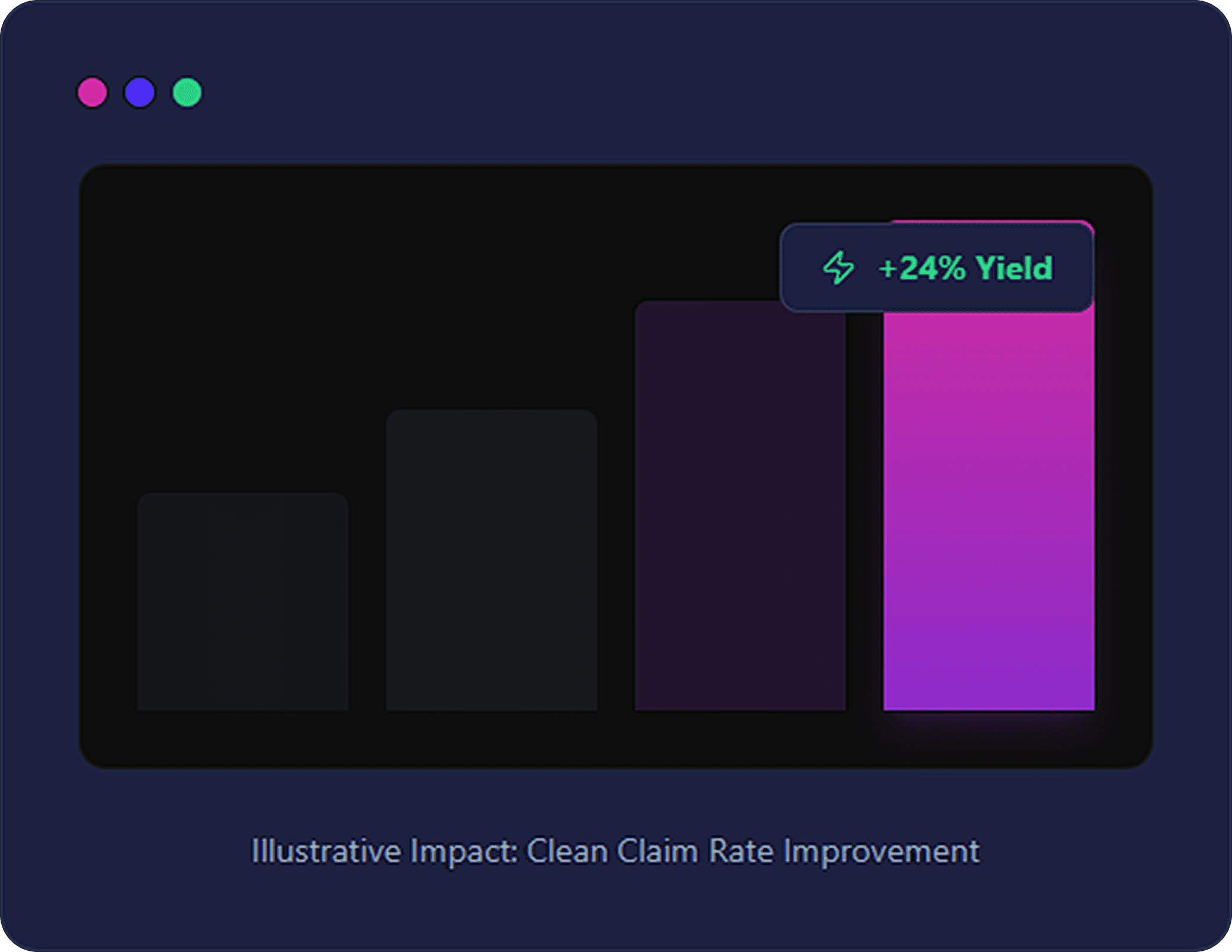
First-pass yield, the percentage of claims accepted and paid without correction or resubmission, is one of the clearest indicators of an efficient revenue cycle. Optora improves it by identifying the conditions that cause denials before claims are submitted, rather than after. For GCC providers, where payer rules across DHA, DOH, and NPHIES create a complex submission environment, this pre-submission review is particularly valuable. Fewer claims come back for rework, payment cycles shorten, and billing teams spend less time on recovery and more time on clean submissions.